
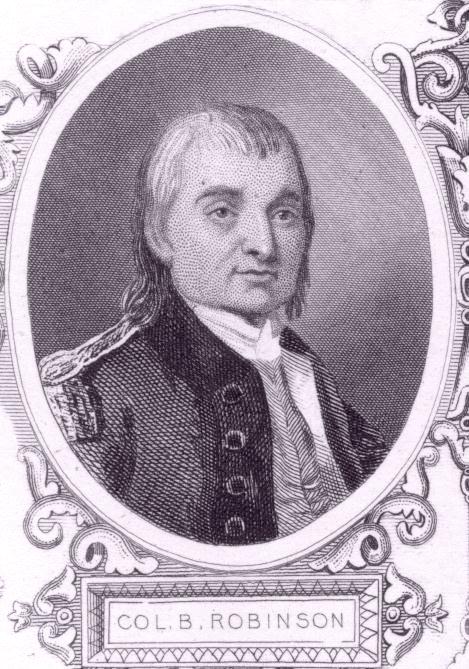
 Raised in mid-March of 1777 by wealthy Beverley Robinson, the Loyal American Regimentconsisted almost entirely of New York loyalists from lower Dutchess and Westchester Counties. Robinson managed sixty thousand acres and 146 tenant farms in Dutchess County. Not surprisingly, his own tenants (and relatives)accounted for a large percentage of the soldiers and officers of the regiment. See a detailed sketch of Robinson & his signature. Raised in mid-March of 1777 by wealthy Beverley Robinson, the Loyal American Regimentconsisted almost entirely of New York loyalists from lower Dutchess and Westchester Counties. Robinson managed sixty thousand acres and 146 tenant farms in Dutchess County. Not surprisingly, his own tenants (and relatives)accounted for a large percentage of the soldiers and officers of the regiment. See a detailed sketch of Robinson & his signature.
|
|
Robinson, a childhood friend of George Washington, was one of the wealthiest men in the New York colony and like any good leader, he played the game of politics well by eventually gaining access to British Commander-in-Chief Sir Henry Clinton. Robinson quickly became Clinton's friend and trusted advisor.
|
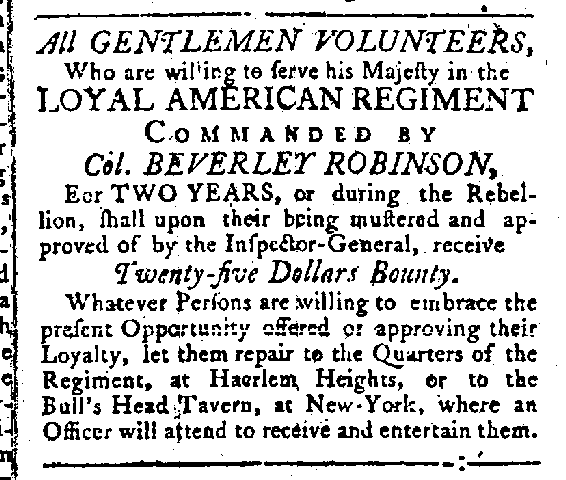 View an actual recruitment notice for the Loyal American Regiment that appeared in 1779 in Rivington's Royal Gazette, a loyalist newspaper printed in British-occupied New York City. View an actual recruitment notice for the Loyal American Regiment that appeared in 1779 in Rivington's Royal Gazette, a loyalist newspaper printed in British-occupied New York City.
|
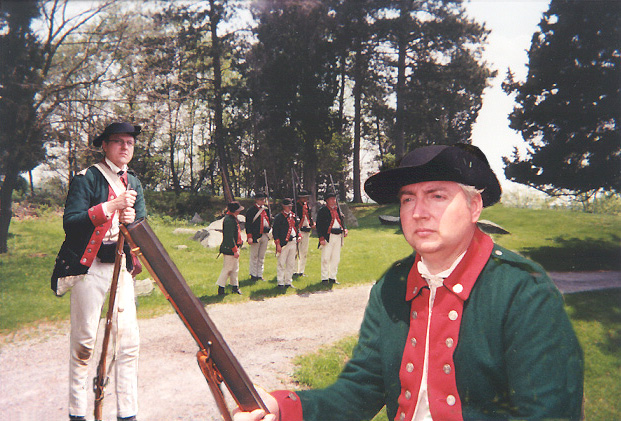
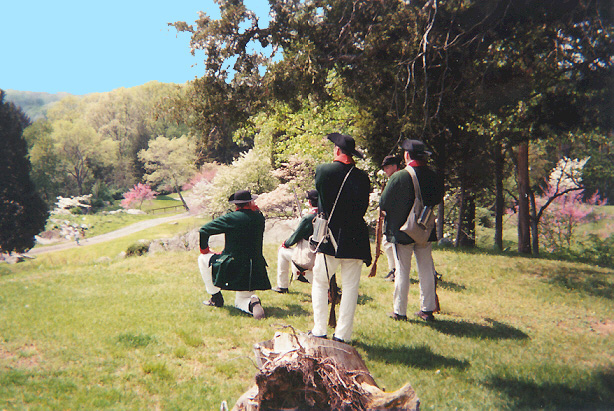 The recreated LAR stands at the exact position in Stony Point's upper works where a detachment of the original LAR was captured in July 1779. |
Robinson's men were quick to distinguish themselves. The Loyal American Regiment participated in the storming of Fort Montgomery on October 6, 1777. First to enter Fort Montgomery was Captain George Turnbull of the Loyal American Regiment. Turnbull had taken command of Major Grant's company of New York Volunteers when Grant himself was killed before the attack on the fort commenced. Sir Henry Clinton subsequently made Turnbull Lieutenant-Colonel of the New York Volunteers.1
|
|
Using a detailed map of the battle at Stony Point, NY, the recreated LAR musters at the exact spot where the original regiment camped in the fort. |
|
About Captain Joshua Barns (Barnes)The recreated Loyal American Regiment portrays Captain Barns' company of the LAR... and an interesting company it was. According to his memorial dated 1786 (Audit Office 13/21), Captain Joshua Barns was an inhabitant of Westchester County NY before the war, and was commissioned by Governor Tryon to recruit as many as possible in his native county. He claimed to have been angered at being offered only an ensign's commission in the New York Volunteers. Later, he joined the LAR as a captain in April of 1777. He was detached to Emmerich's Chasseurs (see below), occupied the barracks at Fort Montgomery NY after a successful action on October 6, 1777 and quite obviously stole rebel property, including a pair of leather breeches for himself (see the fascinating Barnes' court martial proceedings).At his court martial, many LAR officers presented damning testimony yet he was found not guilty of plunder and cowardice in 1779 and went with the LAR to Virginia under Benedict Arnold in 1781. Once there, he is suddenly no longer in the LAR for reasons unknown. Perhaps he resigned, perhaps he was seconded -- the reasons are not entirely clear. Some sources report him dead but one must wonder how could he personally have submitted a memorial for his losses in 1786 if this was the case? According to his memorial he stayed in New York City from July 15, 1783 to March 25, 1784 when he apparantly made his way to New Brunswick, Canada (where the LAR was exiled - see below). Although one of the witnesses for his claim was Lt. Governor Fanning of the Island of St. John (previously the commander of the King's American Regiment), Barnes' claim was rejected on November 29, 1786. He apparantly received no land grant and disappeared to an unknown fate.
LAR DetachmentsMen from the regiment were frequently detached to serve with other regiments -- usually for light infantry warfare. There are three distinct examples of note:In 1777, Captain Joshua Barns and most of his company of the LAR were detached as marksmen to Emmerich's Chasseurs under the command of Andreas Emmerich and were to the right of the LAR's position in the attack on Fort Montgomery in 1777. "Certain light infantry troops were known as Jagers in the German army and as chasseurs in the French army." Encyclopedia of the American Revolution). View an actual muster roll for Captain Barnes' company from 1777. View a composite of muster rolls - collected from various sources - for the entire regiment covering 1777-1783. British Captain Patrick Ferguson took in members of the LAR in 1779 to serve as rangers and riflemen on his ill-fated expedition to South Carolina -- an expedition which ended in disaster at King's Mountain. Lieutenant Anthony Allaire3 of the LAR was at King's Mountain and kept a diary, which became an important record of the British prospective of the battle. Allaire was taken prisoner by the rebels and treated reasonably well although he disliked a congregation of Presbyterians who forced him to listen to one of their sermons. "Horse thieves," wrote Allaire.4 Finally, Captain Morris (son of Beverley) Robinson's company was detached to the corps known as the Provincial Light Infantry under British Lt. Col. John W. Watson of the Brigade of Foot Guards. It is interesting to note LAR influence. Thomas Barclay, the Major for the LAR, served as the Major of the Provincial Light Infantry.
Political IntrigueBesides commanding his regiment, Colonel Beverley Robinson was also deeply involved in the treason of Benedict Arnold. Sometime in 1779, Robinson wrote the following in a letter to Arnold which urged him to help England end the war:"It is necessary that a decisive advantage should put Britain in a condition to dictate the terms of reconciliation . . . There is no one but General Arnold who can surmount obstacles so great as these. A man of so much courage will never despair of the republic, even when every door to a reconciliation seems sealed. Render, then, brave General, this important service to your country . . . Let us put an end to so many calamities. You and ourselves have the same origin, the same language, the same laws . . . Beware, then, of breaking forever the links and ties of a friendship whose benefits are proven . . . United in equality, we will rule the universe, we will hold it bound, not by arms and violence but by the ties of commerce -- the lightest and most gentle bonds that human kind can wear." 5
ExilesAfter the British defeat at Yorktown in 1781, the war slowly ground to a halt as the inevitable outcome became apparent. The only battles left to fight were those at the negotiating table. During this time, many loyalists somewhat cowardly second-guessed their own loyalty to England. Not so with Colonel Beverley Robinson. On August 8, 1782, he wrote to Sir Henry Clinton saying:"I have this consolation,that I acted from upright and conscientious principles, in doing my duty to my king and country, and was it to do over again I should take the same part, for no circumstance in life can ever make me forfeit my loyalty to my king nor zeal for the good of my country."When the war officially ended in defeat for the Crown in 1783, loyalists were forced to leave America. As part of the mass exodus to Canada, the Loyal American Regiment left New York City 6 in the transport ships Ann and Apollo and headed to Fredericton, New Brunswick where they received a land grant known as Block 12. Once there, the men of the regiment started their lives over. Some stayed (Thomas Spragg, for example). Some moved on to other parts of Canada. The upheaval in their lives certainly didn't go unnoticed. In later years, Major Thomas Barclay of the Loyal American Regimentwrote of his former American neighbours 7 : "I find that those who were termed Royalists or Loyalists, in addition to their attachment to their king and country, preserve their priniciples of honor and integrity, of openess and sincerity, which marked the American previous to the year 1773; while those who have sold their king for a Republican Government, have adopted all the frivolity, intrigue, and insincerity of the French, and in relinquishing their allegiance, resigned at the same time, almost universally, religion and morality." 8A harsh, but revealing statement of the loyalists' mindset.

|
|

Transcription of Barnes' memorial: Tom Briggs |
Copyright © 2010,
The Loyal American Regiment