
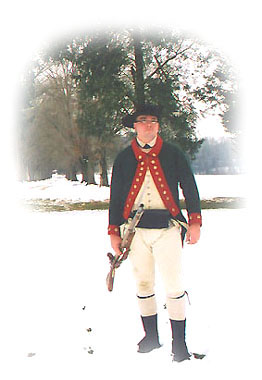
 The Loyal American Regiment (Light Company/ Marksmen) strives to portray soldiers who are proficient with the manual of arms but are also able to adapt to any fighting condition, whether in the field or in the woods, with lightning speed and agility, whether the enemy be foot soldiers or dragoons. We participate in battle demonstrations, camp demonstrations, war games and wilderness treks. We arrive back at camp, more than ready to gather around the campfire and sing Revolutionary War era songs, sometimes quite well, sometimes quite badly.
We try to take our impression very seriously – and ourselves lightly. |
|||
|
We portray the LAR as we believe they would have looked in the early war (1777-1779) with a particular emphasis on Captain Barnes' company when they were detached as marksmen to Emmerich's Chasseurs. (Read the Court Martial proceedings of Captain Barnes.) Our shortened green coats are faced red 1 (the regiment changed over to red coats by early 1780). As opposed to blindly imitating what official sources state was issued (or ordered), we have made a conscious decision that our clothing and accoutrements will reflect realistic modifications made while in the field as well as the use of occasional captured equipment.
Beginning spring 2010, we will occasionally wear red (actually madder) short coats (coatees) with blue facings, one of a few combinations worn late in the war (other years, they were provided coats with green and with buff facings). Light infantry tactics are used and, therefore, a degree of physical exertion is inevitable. Frankly, we run around a lot -- something to keep in mind. Also, you'll have to endure the comments of friends who think you are completely insane because you wear a wool uniform in the middle of summer heat waves. Read the The Advanced Guard: Its purpose & practice.
In addition to adding to the richness of camping events, LAR members also research the time period by pursuing microfilm concerning British and Loyalist people and military provisions. Much of this material is quite obscure and it becomes quite a detective's task to unravel the real story of the war.
One of our recent recruits, Dale Pappas, has written articles on a variety of eras. Other members present civilian or military roles in eras from Vikings to the Spanish-American War.
As a member, you can make your own clothing and accoutrements if you wish but you will have to pass inspection by the commanding officer. Although we try to be threadcounters, we also aren't psycho about it. Read a brief look at gaitered-trousers/ trousers and cut-down coats.
The Loyal American Regiment (Light Company/Marksmen) has a membership throughout the Mid-Atlantic area (from West Virginia to upstate New York). We heartily invite you to take the King's shilling! If you are interested in joining the Loyal American Regiment, please step into The Recruiting Tent.
To read about some of our personal experiences in the reenacting hobby, visit our media page and our "wargasm" pages on Fort Montgomery, NY and the March to Monmouth, NJ. See Unit Events/ Photos to see where we'll be next. View and print an Application Form if you're interested in joining the Regiment or engaging us for an event or program.
|
Copyright © 2010,
The Loyal American Regiment
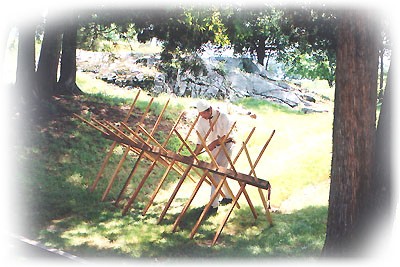 Members of the LAR bring their research to events. At Stony Point, NY, Adam built authentic chevaux-de-frize defense works as visitors watched. Members of the unit assisted Adam in building two more of these before the weekend was over. He has since created chevaux-de-frize specifically for use by the British Brigade.
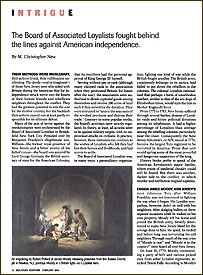 Chris New's article on New Jersey's Board of Associated Loyalists appears in the February 2004 issue of Military History magazine (pictured at right). He has also published other historical articles and a book on Maryland loyalists.
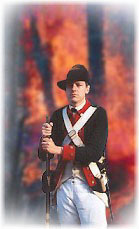 If you're not willing or able to make a regimental coat yourself, you might contact either Sue Walters at
